

One of the most challenging vibration faults to explain, particularly to those outside the vibration community, is structural resonance. This is not because it is rare, but because its behavior does not match everyday intuition.
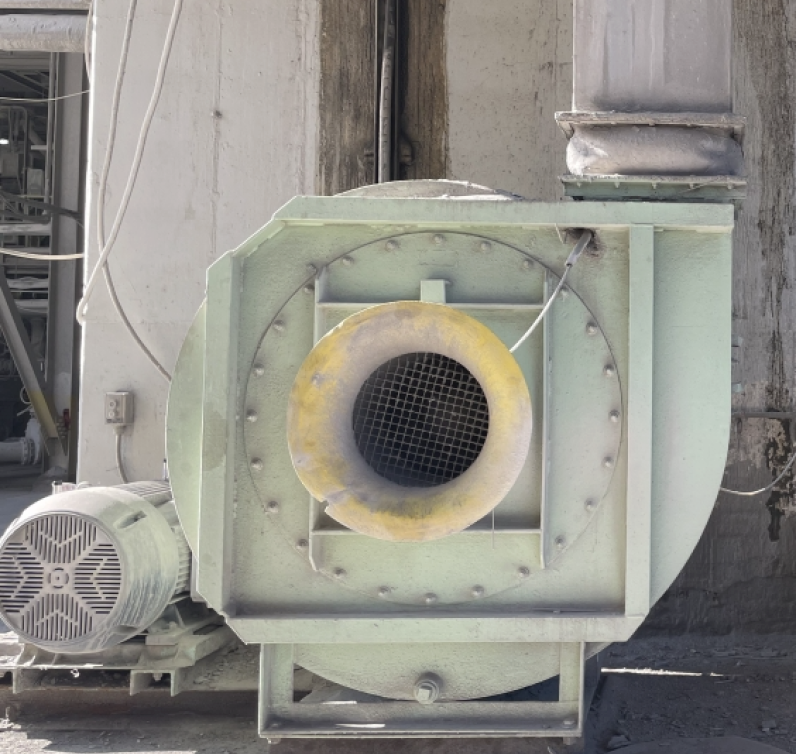
Using Skyler monitoring, a resonance condition was detected in a belt-driven cooling fan at a cement plant. The fan did not consistently exhibit high vibration levels. Its condition did not steadily worsen over time. Instead, the vibration increased sharply when the fan operated within a specific speed range, dropping again as soon as the speed moved away from that range.
To someone unfamiliar with vibration physics, this may seem contradictory. Either a fault exists or it does not. Resonance challenges this assumption.
In this case, a very severe increase in vibration was recorded on both fan bearings. Velocity exceeded 1 in/s and the frequency spectrum showed elevated running-speed components. The 1x component was high, the harmonics were elevated and the 3x fan shaft speed component became dominant under certain operating conditions. The time waveform showed a highly periodic response and autocorrelation analysis revealed three significant events per fan shaft revolution.
As the fan speed shifted from around 1950 RPM towards higher values, the vibration behavior changed abruptly. When the fan shaft speed approached 2040 RPM, the 3x component peaked sharply. This corresponded to a resonance frequency of around 6,120 CPM. When the speed moved above or below this range, the vibration levels dropped again. The machine itself had not changed. Only the excitation frequency had changed.
This behavior was clearly evident in the monitoring data. Overall vibration levels were very high in the resonance zone and significantly lower outside it. From a vibration perspective, the conclusion was straightforward. From a practical perspective, however, it was more difficult to accept.
The supervisor reviewing the case had a reasonable concern: How could a fault appear and disappear on its own? How could vibration be severe one moment and acceptable the next without any mechanical intervention?
The answer is that resonance is not a defect of a single component. It is a dynamic interaction between excitation and structure. The mass, stiffness and damping of the system determine its natural frequency. When the running speed or one of its harmonics aligns with that frequency, the vibration amplifies rapidly. However, when the speed moves away from this frequency, the amplification collapses just as quickly.
Nothing breaks. Nothing repairs itself. The system is simply no longer being excited at its natural frequency.
Rather than debating theory, the team conducted an experiment. They carried out a controlled VFD speed sweep across the operating range and recorded vibration values at fixed speed increments of roughly 50 RPM. The result was clear. Vibration did not increase linearly with speed. Instead, a distinct local maximum centered around a narrow speed band was observed. Below and above that band, vibration levels were much lower.
A bump test was also performed to confirm the natural frequency identified in the spectrum. At this stage, the behaviour could no longer be considered abstract. The resonance was measurable, repeatable, and undeniable.
This case also illustrates why resonance is often missed. A single spectrum taken at one operating speed can appear alarming or completely normal depending on the speed at the time of measurement. Without speed correlation, resonance can be mistaken for looseness or imbalance or even dismissed as noise.
Proper resonance identification requires an understanding of how vibration changes with speed. While harmonic behaviour is important, resonance can appear at running speed, at higher harmonics or even at subharmonics depending on how the structure is excited. Time waveforms often show a clean, sinusoidal forcing function, reflecting structural response rather than impulsive mechanical damage. Coast-up, coast-down or controlled speed-step testing is essential to distinguish resonance from faults that scale proportionally with speed.
If the vibration increases steadily and proportionally to the speed, the root cause is usually an imbalance or misalignment. However, if the vibration peaks sharply at a certain speed and then decreases again, resonance is likely to be the cause.
In this case, the final solution was not mechanical. No bearings were replaced. No shafts were modified. No fan blades were replaced. Instead, the problematic speed range was blocked in the VFD settings, meaning the fan would not operate in the resonance zone.
Once the fan was kept away from that excitation frequency, the vibration levels returned to an acceptable level.
This is why resonance is one of the most elusive fault types in vibration analysis. It does not trend smoothly. It does not obey simple intuition. Furthermore, it is easily dismissed if vibration is viewed only as a static condition rather than a dynamic response.
Sometimes, the fault is not a damaged part. Sometimes it is the speed. Unless you test for it explicitly, it is very easy to miss.
What made this case diagnosable was not a single snapshot or an alarm, but continuous visibility across operating conditions.
Skyler solution makes these faults visible because it captures vibration trends together with speed changes, allowing correlation over time instead of relying on isolated measurements. When speed drifts due to process demand or control logic, resonance reveals itself in the data. Without that continuity, resonance remains easy to miss, easy to dismiss, and hard to explain. With it, the behavior becomes repeatable, measurable, and actionable. In this case, that difference was the line between debating whether a fault was “real” and confidently preventing it by design.
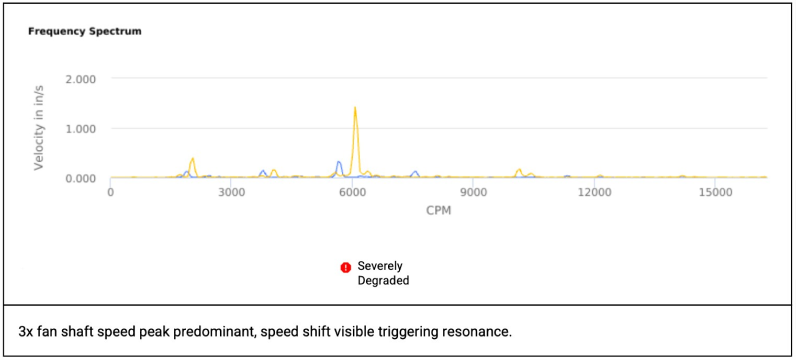
The photo above depicts the shift in the speed peaks observed along with the increased peak amplitudes when the resonance occurs.
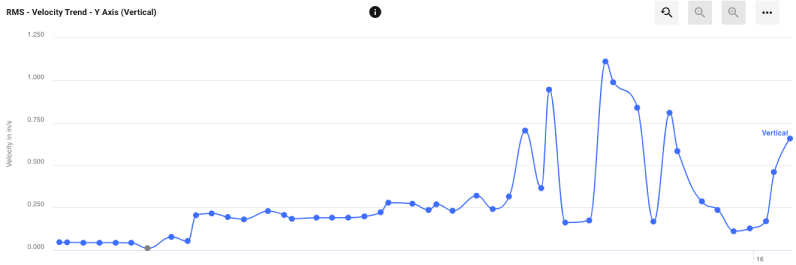
The photo above illustrates how high the vibration velocity RMS values increased when the resonance condition occurred—from below 0.2 IPS when operating outside of critical speed to above 1 IPS (critically destructive levels).
The photo above illustrates how high the vibration velocity RMS values increased when the resonance condition occurred from below 0.2 IPS when operating outside of critical speed to above 1 IPS (critically destructive levels).